FROM SENSORS TO COMMUNITIES
Research for resilient infrastructure
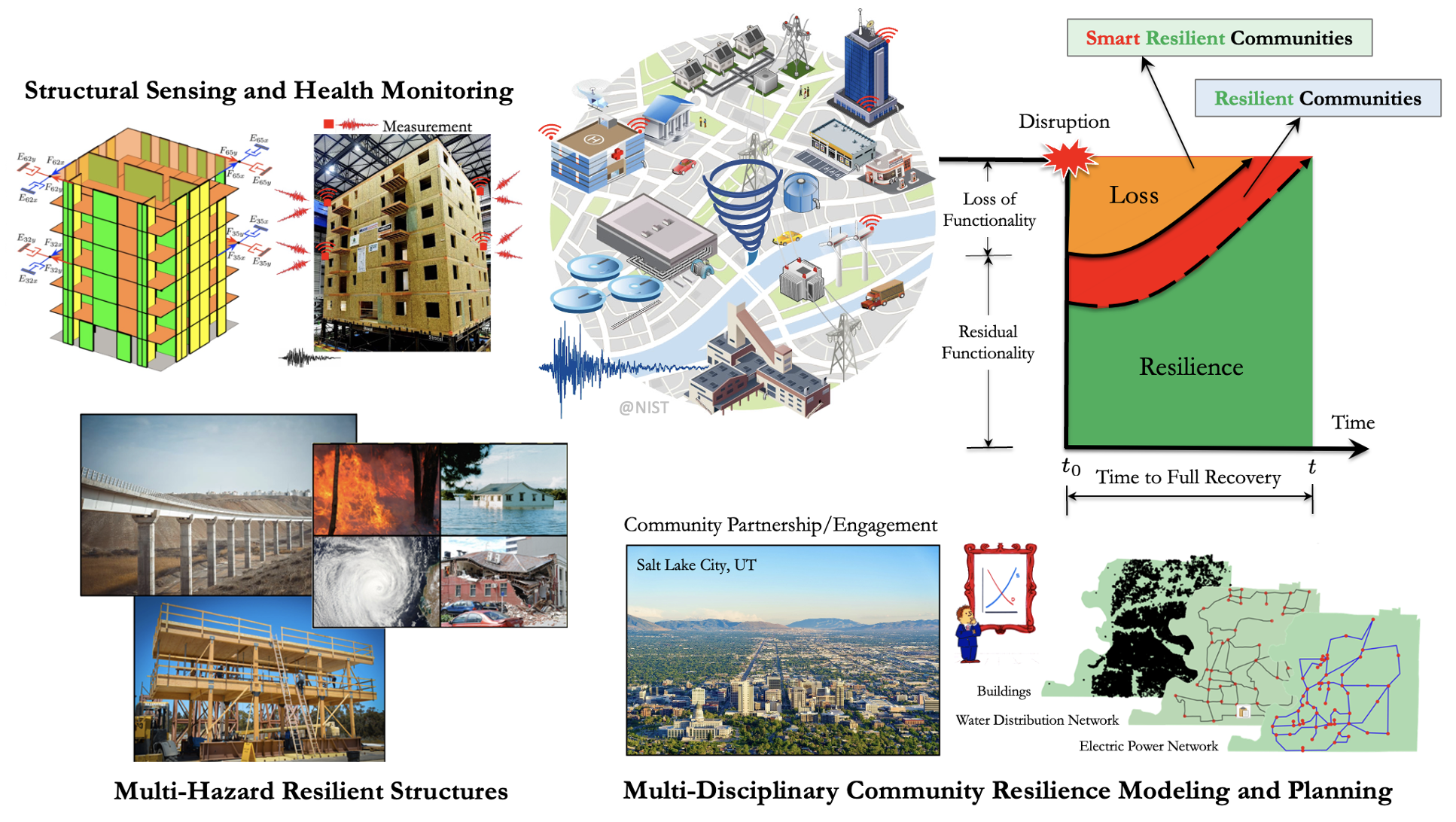
We study how buildings, infrastructure networks, and communities withstand hazards and recover. Our work connects structural dynamics, sensing, and computational models with decisions made by engineers, public agencies, and communities.
Three connected directions guide the lab: digital twins and intelligent monitoring, multi-hazard community resilience, and resilient structural systems. We develop open, reproducible tools for mitigation, design, and recovery, including contributions to IN-CORE.
How we work
From evidence to decisions
01 · Measure
Use sensors, field observations, and infrastructure inventories to understand system behavior.
02 · Model
Combine mechanics, data fusion, and uncertainty analysis from individual structures to community networks.
03 · Decide
Evaluate mitigation, design, and recovery options with stakeholders and open research tools.
Research Themes and Projects
Digital Twins & Monitoring
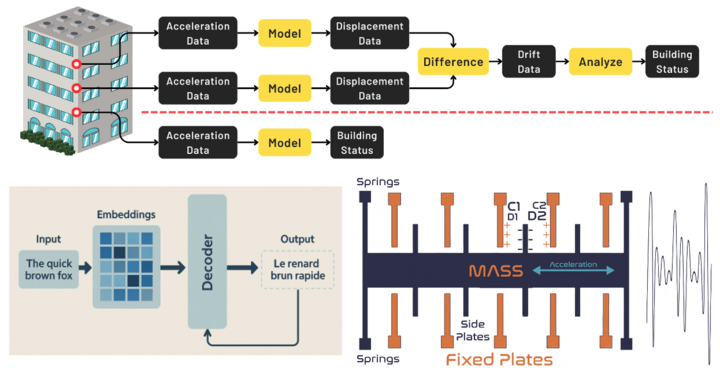
We develop physics-based and data-driven digital twins of buildings and infrastructure systems using structural sensing, data fusion, and health monitoring. Our research focuses on extracting system-level information from sparse and heterogeneous data to characterize damage, functionality, and performance before and after extreme events.
These digital twins support rapid diagnostics, scenario evaluation, and uncertainty-aware decision-making, particularly in post-disaster environments where data may be incomplete or degraded. Applications include instrumented buildings, transportation infrastructure, and critical facilities.
Compounding Hazards
Infrastructure systems are increasingly exposed to interacting and sequential hazards. Our research addresses compounding hazards—including earthquakes, extreme wind, flooding, fire, and climate-driven stressors—by modeling how damage and disruptions cascade across infrastructure networks and communities.
We quantify risk, reliability, and recovery under multi-hazard scenarios while accounting for interdependencies among structural systems, lifelines, and social functions. This work supports hazard-informed planning, mitigation prioritization, and resilience-based design.
Community Resilience
We translate complex models into actionable insights for engineers, planners, and policymakers. Using community resilience modeling, recovery simulation, and scenario analysis, we support decisions related to mitigation investment, retrofit prioritization, and post-disaster recovery planning.
Our work is applied in real communities through partnerships with federal agencies, state and local governments, and resilience platforms, ensuring that analytical tools directly inform practice rather than remain purely academic.
AI, Data Science & Uncertainty
We develop artificial intelligence and data science methods tailored to natural hazards and infrastructure resilience problems. Our work emphasizes physics-informed and interpretable approaches that integrate machine learning with probabilistic modeling and uncertainty quantification.
These methods support rapid damage assessment, performance prediction, and risk-informed decision-making while maintaining transparency and reliability for engineering and policy applications.
Structural Dynamics & Performance-Based Engineering
Our research advances structural dynamics and performance-based engineering methods for assessing and designing resilient structures. We investigate system identification, Bayesian filtering, and dynamic response reconstruction to evaluate damage, functionality, and recovery.
This work provides the mechanical foundation for digital twins, post-event assessment, and resilience-based design of buildings and infrastructure systems.
Project spotlights
Community Resilience Decision Support and Mitigation Planning
National Institute of Standards and Technology (NIST)
This project advances community-scale decision-support methods to define resilience goals, diagnose vulnerabilities, and prioritize mitigation strategies using integrated engineering, social, and economic models.

Transforming Tribal Community Resilience to Extreme Wind
National Science Foundation (NSF)
This NSF-funded project develops a multidimensional framework that integrates engineering, social, and economic models to support extreme-wind resilience planning for tribal communities, with a strong emphasis on equity-centered decision support.

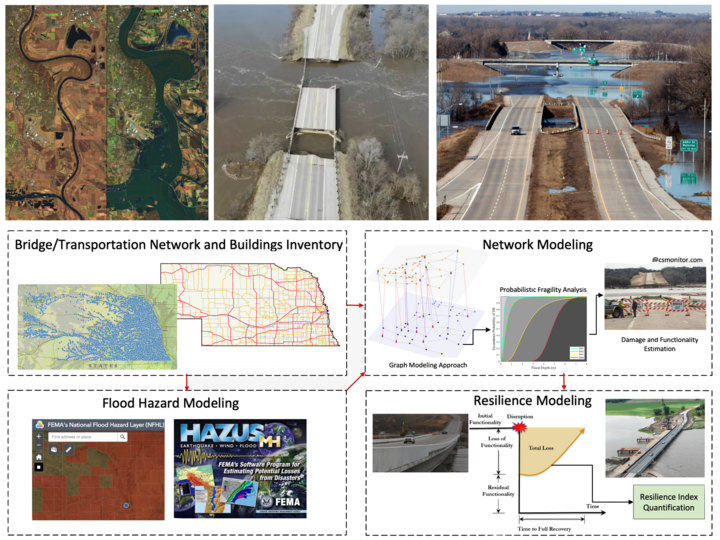
Integrated Bridge, Transportation Network, and Community Resilience
Nebraska Department of Transportation (NDOT)
This NDOT-funded research integrates bridge performance, transportation network disruption, and community impacts to support resilience-informed planning and infrastructure investment.
Funded research & partnerships
Selected current and recent projects connect engineering methods with practical decisions for communities, transportation agencies, and infrastructure owners.
Current portfolio
- Open-source community resilience: NSF POSE Phase II supports the IN-CORE ecosystem, August 2026–July 2028. Roohi is a co-PI on the Colorado State University-led collaboration.
- Bridge and transportation networks: NDOT supports an integrated bridge, network, and community resilience framework, extended through May 2027. Project record.
- Weather-resilient airports: NASEM/TRB Airport Cooperative Research Program supports investment and planning guidance, 2026–2027. Roohi serves as PI.
- Infrastructure and public health recovery: Nebraska Research Initiative / NU Collaboration Initiative support connects infrastructure disruption with recovery under compounding hazards, 2026–2027.
- Transmission system reliability: UNL Collaboration Development support advances resilient power infrastructure, 2026–2027.
- Rail infrastructure monitoring: University of South Carolina-led research uses onboard vibration measurements and edge computing to detect lateral strength changes, 2025–2027.
- Accessible smart environments: NSF EPSCoR Research Fellows support, led by Montana Tech with UNL as host collaborator, advances multi-sensor environments for individuals with functional limitations.
- Tornado preparedness and communication: Montclair State University’s Center for Cooperative Media supports civic science in Elkhorn, Nebraska, 2025–2027.
Recent foundations & continuing collaborations
- NIST / IN-CORE: Community functional recovery and multidisciplinary decision support through PREP and related collaborations.
- NSF CIVIC-PG: Tribal community resilience to extreme wind, 2024–2025.
- Mid-America Transportation Center: Equitable flood-risk mitigation for Nebraska transportation, 2024–2026.
- University of Nebraska Omaha: Nonlinear model-data fusion for aeronautical infrastructure monitoring, 2024–2025.
- UNL Grand Challenges and Durham seed support: Climate-resilient Heartland research, digital-twin verification and uncertainty quantification, and bio-inspired MEMS sensing.
Structural, Infrastructure and Community Systems Testbeds
We develop and apply community-scale testbeds to evaluate multi-hazard risk, infrastructure interdependencies, and recovery dynamics. These testbeds integrate physical infrastructure, social systems, and data-driven models to support resilience planning and decision-making.
Seismic SHM
NEESWood Instrumented Building
Full-scale instrumented building testbed
This testbed uses a full-scale instrumented wood building from the NEESWood project to study seismic response, damage detection, and performance assessment. Dense sensing and data-driven modeling support the development and validation of digital twins and structural health monitoring methods for earthquake engineering applications.
Multi-Hazard Risk
Memphis–Shelby County, Tennessee
New Madrid seismic zone
This testbed focuses on seismic risk and recovery in the New Madrid seismic zone, integrating building performance, lifeline systems, and community impacts to inform resilience planning and emergency preparedness.
Explore the IN-CORE seismic resilience analysis notebookEarthquake Resilience
Salt Lake City, Utah
Unreinforced masonry buildings and community recovery
This testbed evaluates seismic risk and recovery for unreinforced masonry buildings and interdependent infrastructure systems. Results have supported data-informed retrofit prioritization and community resilience planning through partnerships with local stakeholders.
Watch the Salt Lake City Resilience TestimonialExtreme Wind
Tornado-Affected Communities
Community-scale wind hazard resilience
We develop testbeds for communities affected by extreme wind and tornado hazards to assess building vulnerability, infrastructure disruption, and recovery processes, with emphasis on risk communication and decision support.
Flooding & Climate Impacts
Nebraska Flood Resilience Testbed
Transportation and community infrastructure systems
This testbed focuses on flood impacts and recovery of transportation and community infrastructure systems in Nebraska. The work integrates infrastructure performance, network disruption, and recovery modeling to support flood resilience planning, adaptation strategies, and hazard-informed decision-making at the local and regional scales.
Urban Systems
Los Angeles County, California
Infrastructure interdependencies and recovery modeling
We developed a community-scale testbed to analyze infrastructure performance, economic impacts, and recovery trajectories under seismic hazards. The testbed supports evaluation of mitigation strategies and policy-relevant resilience metrics.
Research Project Highlights
Multi-Disciplinary Decision Support for Community Resilience (NIST)
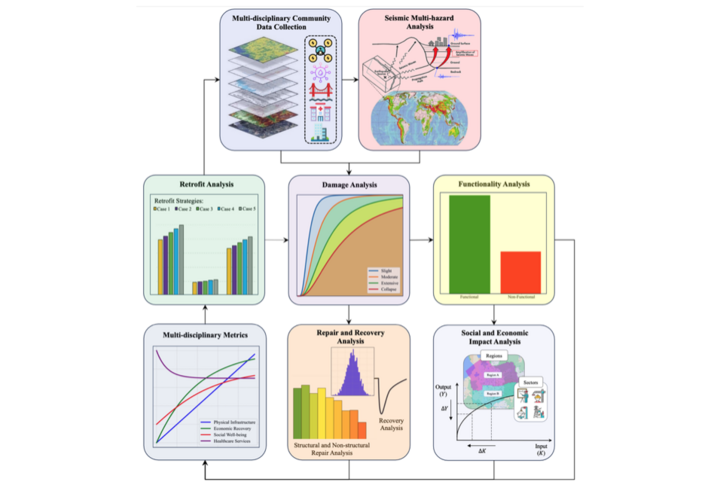
This project develops a multi-disciplinary decision-support methodology to assist communities in defining, evaluating, and achieving resilience goals under earthquake hazards. The framework integrates engineering, social, and economic models within the IN-CORE platform to quantify damage, functionality, recovery, and socio-economic impacts.
In partnership with the NIST Center for Risk-Based Community Resilience Planning, the methodology has been implemented for community resilience planning in Salt Lake County, Utah. Decision-makers define target resilience objectives, which are used to diagnose vulnerable building archetypes, prioritize retrofit strategies, and estimate the costs required to meet community-defined resilience goals.
Performance-Based Post-Earthquake Decision-Making for Instrumented Buildings (NSF)
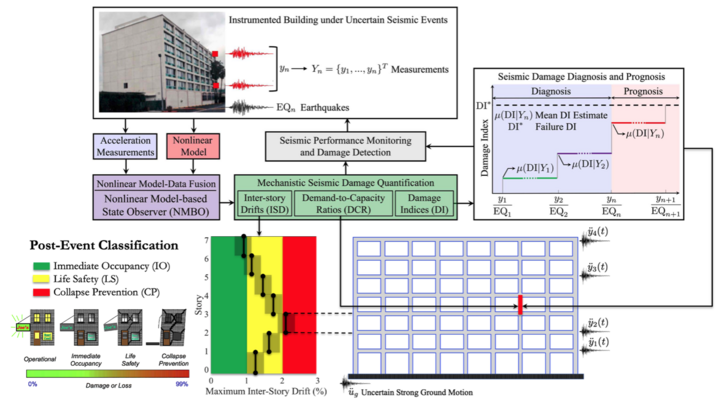
This NSF-funded project developed a probabilistic framework for post-earthquake assessment of instrumented buildings that is consistent with performance-based design principles. The framework integrates seismic structural health monitoring with performance-based earthquake engineering through measurement, uncertainty modeling, response reconstruction, damage estimation, and decision analysis.
The methodology is demonstrated using data from the Van Nuys Hotel testbed, a seven-story reinforced concrete building instrumented by the California Strong Motion Instrumentation Program. The outcomes support risk-informed decisions by building owners, emergency managers, and public agencies.
Seismic Functionality and Restoration of Interdependent Infrastructure Systems (NIST)
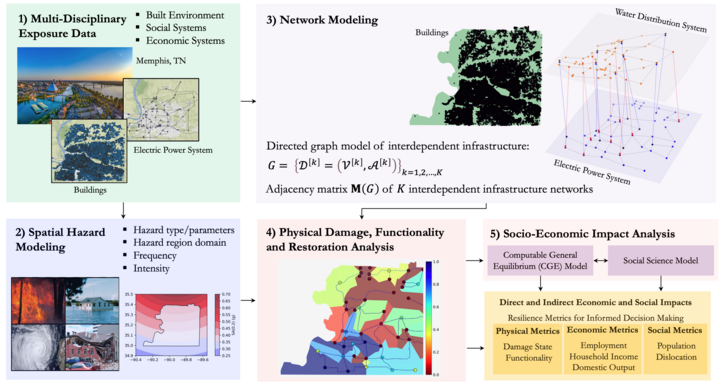
This project investigates seismic functionality and restoration of interdependent building, water, and power systems at the community scale. The research develops a systematic approach to quantify physical damage, service disruption, and recovery trajectories using integrated engineering and socio-economic models.
The methodology is demonstrated for the Memphis–Shelby County region using the IN-CORE platform, providing a foundation for interactive Jupyter-based analysis of restoration curves and interdependent system recovery. The results support resilience-informed planning for critical infrastructure systems.
Intelligent Sensing and Bio-Inspired Technologies for Rapid Post-Disaster Assessment
This project explores low-cost, bio-inspired sensing technologies and neuromorphic computing approaches for rapid post-earthquake assessment of buildings. By combining novel sensing hardware with model–data fusion and probabilistic inference, the research aims to enable scalable and timely damage diagnostics following extreme events.
The work supports future digital-twin-enabled monitoring and decision-making under data-limited conditions.