
As an educator, Dr. Roohi is passionate about sharing his knowledge and expertise with students. He teaches classes on Engineering Statics, Timber and Masonry Design, and Reliability of Structures and has developed a new course on Infrastructure and Community Resilience, aiming to provide students with a strong foundation in engineering principles and prepare them for the challenges of designing resilient and sustainable infrastructure.
This page provides an overview of the undergraduate and graduate courses I am currently teaching in the Durham School of Architectural Engineering and Construction and the Department of Civil and Environmental Engineering at the University of Nebraska–Lincoln (UNL).
For the full list of offerings, see the UNL course catalog.
Teaching Philosophy
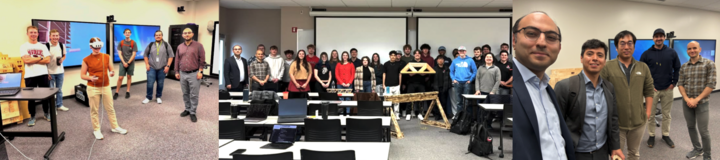
My teaching emphasizes conceptual clarity, real-world relevance, and student-centered learning. I aim to help students develop physical intuition, analytical thinking, and structured problem-solving skills, while connecting engineering principles to practice in safety, resilience, and sustainability. I incorporate active learning, computational tools, and timely feedback, and I continuously improve my courses based on student input.
GRADUATE / ADVANCED UNDERGRADUATE COURSE
AREN 894 Infrastructure & Community Resilience
Multi-hazard systems and recovery
Focuses on resilience-based engineering of interconnected infrastructure and communities under earthquakes, wind, flooding, and climate-driven hazards. Topics include performance-based design, recovery modeling, cascading failures, equity considerations, and decision support tools.
Undergraduate Course
MECH 223 Engineering Statics
Fundamentals of equilibrium and mechanics
Introduces the principles of statics for engineering systems, including force systems, equilibrium of particles and rigid bodies, trusses, frames, friction, and distributed loads. Emphasis is placed on conceptual understanding, problem-solving strategies, and real-world engineering applications.
Graduate Course
CIVE 459/859 Structural Reliability
Probability, uncertainty, and risk-informed design
This course introduces probabilistic methods for analyzing and designing structural and infrastructure systems under uncertainty. Topics include random variables and processes, reliability indices, failure probability estimation, Bayesian updating, and risk-informed decision-making. Emphasis is placed on applications to structural performance, natural hazards, and resilience-based engineering.
Graduate / Advanced Undergraduate Course
AREN 851 Masonry & Timber Design
Design of resilient structural systems
Introduces design principles for masonry and timber structures, emphasizing load paths, material behavior, code-based design, and performance under extreme loads. Real-world examples connect structural design to sustainability and resilience objectives.
Learning Environment & Mentorship
Beyond the classroom, I mentor undergraduate and graduate students through research projects, independent studies, and professional development activities. My courses are designed to encourage curiosity, collaboration, and confidence, and many students transition from coursework into funded research, conference presentations, and national research programs.
I strive to create an inclusive and supportive learning environment where students feel comfortable asking questions, exploring new ideas, and developing the skills needed for graduate study, industry practice, and interdisciplinary collaboration.
Research & Learning Opportunities
Students are encouraged to extend classroom learning through undergraduate and graduate research opportunities in the SiRIUS Lab, with projects grounded in real-world infrastructure and resilience challenges.